Pokazywanie postów oznaczonych etykietą Warszawa. Pokaż wszystkie posty
sobota, 16 marca 2013
Warszawa 1935
Aaaaa, tak mi się wczoraj wydawało że "Puder Anitra" na filmie Warszawa 1935 to pomyłka. No bo jak mogłabym przeoczyć markę reklamowaną w tak reprezentacyjnym punkcie miasta. Oczywiście, że chodziło o reklamę Antiby. Polecę obejrzeć drugi raz, ale jakby ktoś z czytelników mógł rzucić okiem oglądając film, bo wydaje mi się, że jeszcze lokalizacja względem reklamy mydła Majde została przesunięta.
poniedziałek, 12 marca 2012
Reklamy sygnowane cz 6.
Reklama mydła dla dzieci Pulsa. Sygnowana J. Zoller (?-?).
Signed advertisemsnts part 6.
Puls' baby soap ad. Signed J. Zoller (?-?).
niedziela, 15 stycznia 2012
Gwiazdy ekranu reklamują kosmetyki
Wspieranie kampanii reklamowych kosmetyków wizerunkami
gwiazd ekranu jest tak starym zabiegiem jak sama historia srebrnego ekranu i
przemysłowej produkcji kosmetyków. Czytelnicy prasy polskiej pod koniec lat
trzydziestych mieli okazję, podobnie jak dziś, obejrzeć reklamy importowanych kosmetyków
Max Factor, zachwalanych przez hollywoodzkie gwiazdy. Wizerunkiem Normy
Schearer wspierało swoją kampanię mydło toaletowe Lux (Schicht-Lever S.A.),
Pola Negri występowała w reklamach kosmetyków Śnieg Tatrzański Falkiewicza.
Najdalej w tego typu kampanii poszła poznańska fabryka kosmetyków Żaka wydając
albumik z fotosami polskich aktorów i aktorek okraszonymi reprodukcjami
autografów zachwalających kosmetyki Żaka. W prasie odbiciem tej kampanii były
reklamy Przemysławki, którą promował Jan Kiepura. Żak zresztą, dość złośliwie, opatrzył
albumik mottem „cudze chwalicie, swego nie znacie, sami nie wiecie co
posiadacie”, co było aktualne zarówno w odniesieniu do gwiazd ekranu jak i
kosmetyków.
na rysunkach:
Ada Sari w albumie reklamującym kosmetyki Żaka
Norma Schearer w reklamie mydła Lux
Pola Negri w folderach reklamowych Falkiewicza
Reklama prasowa kosmetyków Max Factor
Backing up
an advertising campaigns of cosmetics with images of movie stars is such an old
trick as very history of the cinema and the industrial manufacture of
cosmetics. Readers of the Polish press
at the end of thirties were supposed, as similarly as today, to watch the
advertisements of imported Max Factor cosmetics recommended by Hollywood
stars. The Lux bath soap (Schicht-Lever
S.A.) supported its campaign up with the image of Norma Scheare, Pola Negri appeared in ads of Snieg Tatrzański [Tatra Snow] cosmetics by Falkiewicz.
Farthest in the campaign of this type a Poznań Żak's factory of
cosmetics went publishing the small book with stills of Polish actors and
actresses spiced up with reproductions of autographs recommending Żak perfumes
and beauty treatments. In the press this campaign was refelected by
Przemysławka ads which promoted Jan Kiepura.
Żak as a matter of fact, quite maliciously, provided the small book of
illustrations with the epigraph meaning "the grass is always greener on
the other side of the fence, alone you don't know what you have" what was
still standing both with reference to movie stars as well as cosmetics.
on pictures:
Ada Sari advertising beauty treatments by Żak
Norma Schearer in the advertisement of Lux soap
Pola Negri in an advertising brochures of Falkiewicz
Press ad of Max Factor cosmetics
środa, 2 listopada 2011
sobota, 20 sierpnia 2011
Gdzie by tu się zareklamować - cz. 10
A tym razem nie mam pojęcia do czego służył ten przedmiot. Mała, płytka miseczka z dziurką, służącą prawdopodobnie do przykręcenia tejże miseczki do czegoś. Trochę za mała chyba jak na miseczkę na drobne, przykręcaną do lady sklepowej (średnica 5,5cm). W każdym razie reklama dotyczy zaprawy do podłóg "Jaśniej Słońca" produkowanej przez warszawską Fabrykę przetworów techno-chemicznych "Mary".
And this time I do not have a clue what this object was used for. Small, shallow bowl with the hole, probably for screwing this bowl to something. A bit too small as a bowl for change, screwed to the shop counter (diameter 5.5 cm). In any case the advertisement is regarding floor pretreatment Jaśniej Słońca [brightly than the Sun] produced by the Warsaw factory Mary (Fabryka przetworów techno-chemicznych "Mary").
poniedziałek, 25 lipca 2011
Przez dziecko do matki cz. 3
Właściwie to ten wpis pasuje również do kategorii “reklama i edukacja”. Plan lekcji ze skaczącym jeleniem udającym herb miejski Schicht wydał najprawdopodobniej na początku lat dwudziestych, przed kupnem warszawskiej fabryki na Szwedzkiej , no i oczywiście przed połączeniem z Leverem (1935). Stąd na rewersie informacja o produkcji mydła przez warszawską spółkę Saturnia (… w fabryce na Szwedzkiej). Saturnia była w połowie lat dwudziestych spółką zależną od Schichta, na jej potrzeby produkowała mydło przez pewien czas również fabryka mydła w Trzebini (w 1927roku również przejęta przez Schichta).
By the child to the mother part 3.
Actually this entry fits the category “an advertisement and an education” also. A school timetable with the jumping stag, imitating the municipal coat of arms, Schicht published most probably at the beginning of 1920’s, before the purchase of the Warsaw soap factory on Szwedzka Street, and of course before the connection with Lever (1935). Hence on the reverse information about the production of soap by the Warsaw Saturnia company (… in the factory on Szwedzka Street). Saturnia was in mid-twenties a Schicht's subsidiary, for some time a soap factory in Trzebinia also produced soap for Saturnia (in 1927 taken over by Schicht).
[What the child should know about soap.
Dirt is the biggest enemy of the mankind. Dirt is heightening illnesses and causes a mushroom growth of imperceptible with eye pathogenic germs. Holding the body and clothes in the due purity is the best security against illnesses, specially whereas children obligatorily must several times per day wash hands and the face. Tiny Johny doesn't like the bath and is heavily screaming, whenever the mummy is starting washing him. Older children know that they must be clean and they are inviting washing themselves some more, because shame is to appear in stained clothes or with dirty hands. Children know very well that not every soap is good; some are stinging and pinching after washing, because contain harmful additives. Without a doubt the best soap is the Soap “Stag-Schicht”, manufactured of precious raw materials by the company Saturnia in Warsaw. Children should always ask parents to buy only the soap “Stag-Schicht”. The authentic piece of “Stag-Schicht” soap looks as:]
poniedziałek, 18 lipca 2011
Gdzie by tu się zareklamować - cz. 8
Zeszyt do rachunków domowych reklamujący kosmetyki Antiba. Zwróćcie uwagę na specjalną rubrykę na wpisywanie wydatków na kosmetyki tej marki.
The special notebook for household calculations advertising Antiba cosmetics. Point out the special column for writing down expenses on cosmetics and toiletries of this brand.
niedziela, 17 lipca 2011
Odsiwiacze
Receptury farb do włosów w dwudziestoleciu międzywojennym zdecydowanie różniły się od dzisiejszych. Dominowały tzw. farby metaliczne, oparte na solach metali, rozpoczynało się dopiero stosowanie, popularnych dziś, barwników oksydacyjnych i bezpośrednich. Jedną z grup preparatów opartych na solach metali były odsiwiacze. Pozwalały one na, mniej lub bardziej stopniowe, nadanie włosom siwym ciemnego koloru. Podstawowym typem receptury był wodny roztwór soli ołowiu lub bizmutu z dodatkiem tiosiarczanu sodu. Potraktowane takim roztworem włosy stopniowo ciemniały (na powierzchni włosów powstawały ciemno zabarwione tlenki i siarczki). Inny typ receptury był zbliżony do typowych ówczesnych farb do włosów - włosy najpierw zwilżano roztworem soli metalu a potem wodno-alkoholowym roztworem pirogallolu, który powodował szybkie pojawienie się ciemnego odcienia. Oczywiście reakcje tworzenia związków barwnych przebiegały wyłącznie na odcinkach włosów potraktowanych preparatem, zawsze więc po pewnym czasie powstawały odrosty i barwienie trzeba było powtarzać.
Odsiwiacze były przygotowywane w drogeriach, pojawiały się także jako gotowe wyroby rynkowe, sprzedawane w perfumeriach. Marką przedwojennego odsiwiacza do dziś pamiętaną jest Orientine, przed wojną oferowana przez warszawską firmę Parfumerie d’Orient, po wojnie przejęta przez INCO.
Na rysunkach:
Reklama sklepowa odsiwiacza Hennina (Lanovit, Warszawa), późne lata trzydzieste
Reklamy prasowe Orientiny, lata trzydzieste
Preparations for grey hair darkening
Formulations of hair dyes in the interwar period definitely differed than today's. So-called metallic dyes, based on salts of metals dominated, oxidative and direct dyes, popular today, just started their history. One of groups of preparations based on metal salts were preparations for grey hair darkening. They allowed, more or less gradual, giving grey hair the dark colour. The basic type of formulation was water solution of lead or bismuth salt with the addition of sodium thiosulfate. Treated with such solution hair gradually darkened (on the surface of hair dark-coloured oxides and sulfides were formed). Other type of the formulation was similar to typical contemporary hair dyes - hair at first was being moistened with solution of the metal salt and then with pyrogallol hydroethanolic solution which caused fast appearance of a darker tone. Of course reactions of forming colour compounds ran exclusively on sections of hair treated with the preparation, so after the certain time grey regrowths have always come into existence and it was necessary to repeat colouring.
Preparations for grey hair darkening were formulated in drugstores, appeared also as industrial-scale produced cosmetics at perfume shops. Well-known prewar brand of the preparation, still remembered today, was Orientine, before the II WW offered by Warsaw company Parfumerie d'Orient, after the war the brand was taken over by INCO company.
On pictures:
shop advertisement of Hennina brand preparation for grey hair (Lanovit, Warsaw), late 1930's [Hennina is restoring grey hair original natural colour]
press ads of the Orientine, 1930's [Orientine - for grey hair - is restoring gradually and slightly the original natural colour, the lustre and the softness. Orientine is unconditionally harmless.]
piątek, 24 czerwca 2011
Gdzie by tu się zareklamować - cz. 7
Tym razem jeszcze jedna bibuła reklamująca produkt fabryki Dobrolin - płyn do czyszczenia metali, marmuru i luster.
This time another blotting paper advertising the product of the Dobrolin factory - cleaning fluid for metals, marble and mirrors.
czwartek, 23 czerwca 2011
Laboratorium Perfection
Laboratorium Perfection było jedną z najważniejszych warszawskich firm kosmetycznych w dwudziestoleciu międzywojennym. Asortyment nie dorównywał co prawda swoim rozmachem asortymentowi Pulsa, ale był bogaty i łącznie z kosmetykami importowanymi przez tę firmę obejmował wszystkie najważniejsze segmenty ówczesnego rynku kosmetycznego. Sztandarową marką Laboratorium Perfection była marka Abarid (w ofercie: krem, otrąbki do mycia twarzy, mydło, puder), swoją obecność w reklamach zaznaczał także krem do rąk o nazwie „Krem Prałatów”. Poza tym firma oferowała inne kremy, w tym do opalania, olejek do opalania, produkty do barwienia włosów, szampony, depilator, produkty przeciwpotne i inne kosmetyki. Laboratorium Perfection posiadało wyłączność na sprzedaż w Polsce francuskich marek Petrole Hahn (pielęgnacja włosów i skóry głowy) i Eau Vegetal (farby do włosów).
Kosmetyki produkowano początkowo przy ulicy Szpitalnej 10, później Śniadeckich 16, natomiast sklep firmowy mieścił się przy Marszałkowskiej 109. Właścicielem firmy był Stefan Pikulski, członek Związku Fabrykantów Wyrobów Perfumeryjno-Kosmetycznych i Mydeł Toaletowych w Polsce, założonego w 1921r. Laboratorium Perfection i jego marki nie przetrwały wojny.
Reklama płynu do przyciemniania brwi i rzęs z okładki wydawnictwa reklamowego Laboratorium Perfection
Laboratorium Perfection (The Perfection Laboratory) was one of the most important Warsaw cosmetic companies in the interwar period. Admittedly the assortment didn't equal with Puls’ assortment, but it was quite wide an, including cosmetics imported by this company, embraced through all most important sections of the contemporary cosmetic market. An Abarid brand was a flagship brand of the Laboratorium Perfection (in stock: cream, oat brans for washing the face, soap, powder), in advertisements also a hand cream named Krem Prałatów [Cream of Prelates] made its presence. Apart from that the company offered other creams, suntan cream and oil, products for dyeing hair, shampoos, depilatories, antiperspirant products and other beauty treatments. The Perfection laboratory had an exclusiveness for sale in Poland of French brands Petrole Hahn (scalp and hair care) and Eau Vegetal (hair dyes).
Cosmetics were produced at the Szpitalna street 10 and later at the Śniadeckich street 16, however the shop selling own-label products was located at the Marszałkowska street 109. Stefan Pikulski was the company owner, member of the Union of Manufacturers of Perfume-cosmetic Products and Toilet Soaps in Poland, established in 1921r. Laboratorium Perfection and its brands didn't survive the II WW.
on pictures:
The cover and two inside pages of the price list of the Laboratorium Perfection from 1933
Press advertising of Abarid powder, 1930's [Cosmetics main principle is to use plant-based powder, not blocking pores, granting the freshness the complexion and mats, in the shade of the complexion. So there is plant-bassed, prepared on powdered bulbs of the white lily Abarid powder]
Press advertising of Cream of Prelates, 1930's [Hands smooth and white as the satin, without wrinkles and reddenings ensures the reliably softening and bleaching the epidermis Cream of Prelates]
Advertisement of liquid for darkening the eyebrow and eyelashes from the cover of the publication of the advertising Perfection Laboratory
niedziela, 12 czerwca 2011
Reklamy sygnowane cz 3.
Reklamy sklepowe wyrobów fabryki Koloryt z 1940 roku. Sygnowane: S. Jasiński.
Shop advertisements of products of the Koloryt factory from 1940. Signed: S. Jasiński.
sobota, 11 czerwca 2011
wtorek, 7 czerwca 2011
Kosmetyki radioaktywne
Kosmetologia dwudziestolecia międzywojennego czerpała bardzo wiele z ówczesnych odkryć naukowych, nie tylko tych dotyczących bezpośrednio skóry. Jak to i dzisiaj bywa, wiele z tych zaczerpnięć było związanych z podążaniem za modą a nie tylko z możliwymi do udowodnienia efektami działania. Fascynacja zjawiskiem promieniotwórczości znalazła więc oczywiście swoje odbicie w obrazie rynku kosmetycznego. Jak donosi polskie wydanie podręcznika Gatefosse’a: „Liczba środków kosmetycznych radioaktywnych wzrasta z każdym dniem. Należy stwierdzić, iż publiczność przyjęła z dużym zainteresowaniem wprowadzenie tego nowego i tajemniczego poniekąd czynnika, do środków kosmetycznych, celem zachowania młodości i piękna”. Gatefosse zauważa jednak, że kluczem do skuteczności tego typu preparatów jest utrzymanie odpowiedniego poziomu promieniowania przez cały okres przechowywania i stosowania kosmetyku i że producenci utrzymują w tajemnicy sposób zachowania tejże. Z pewnością większe szanse na utrzymanie odpowiednich parametrów miały kosmetyki przygotowywane w drogeriach na zamówienie. Recepturę kremu radioaktywnego dla skóry suchej podaje m.in. receptariusz Bennetta z 1937 roku (na rysunku poniżej), jak widać bazowano w tym przypadku na solach radu i toru.
Najpopularniejszą międzynarodową marką kosmetyków radioaktywnych była francuska marka Tho-Radia, obecna również na rynku polskim. Kosmetyki Tho-Radia zawierały chlorek toru i bromek radu. Historię marki można znaleźć tu. W drogeriach można było dostać i inne produkty radioaktywne, nie tylko do celów kosmetycznych, jako przykład - reklama soli radowo-jodowej z czasopisma dla drogistów.
The cosmetic of the interwar period ladled a lot from contemporary scientific discoveries, not only of the ones concerning the skin directly. As today a lot of activities was associated with following the fashion rather than with real activity and efficacy. So fascination for the phenomenon of the radioactivity found its reflection in the cosmetic market of course. The Polish edition of the Gatefosse’s textbook reports: "Number of radioactive cosmetic remedies is growing with each passing day. One should state that the audience accepted introduction of this new and, in a way, secret factor to cosmetic remedies with great interest, in order to keep the youth and the beauty ". However Gatefosse notices that keeping the appropriate level of radiation for the entire storage period is a key to the effectiveness of preparations of this type and producers are keeping secret the way of maintaining this. So, cosmetics prepared on demand in drugstores had a better chance to keep right parameters, certainly. Among others the Bennett’s formulary from 1937 presents the prescription for radioactive cream for dry skin (on the picture above), as one can see in this case the cream was based on salts of radium and thorium.
A French Tho-Radia brand was the most popular international brand of radioactive cosmetics, present also on the Polish market. Tho-Radia cosmetics contained thorium chloride and radium bromide as the source of radioactivity. It is possible to find the history of the brand here. In drugstores it was possible to get other radioactive products, not only for cosmetic purposes, as the example - advertisement of the radium-iodine salt from the druggist's professional magazine.
on pictures:
Formulation of radioactive cream for dry skin (H.Bennett, The Cosmetic Formulary, London 1937)
Press advertisings of cosmetics Tho-Radia, 1930's [Tho-Radia creams, powders and lipstick are the source of the beauty. Tho-Radia cream and powder - source of the youth of the complexion]
Press ad of radium-iodine salt, 1930's [Radium-iodine salt "Galen". Article which isn't disappointing. In view of the heightened propaganda in the circles of medicine doctors and the therapeutic period we are advising to get the radium-iodine salt.]
piątek, 20 maja 2011
wtorek, 3 maja 2011
Uroda Pulsa
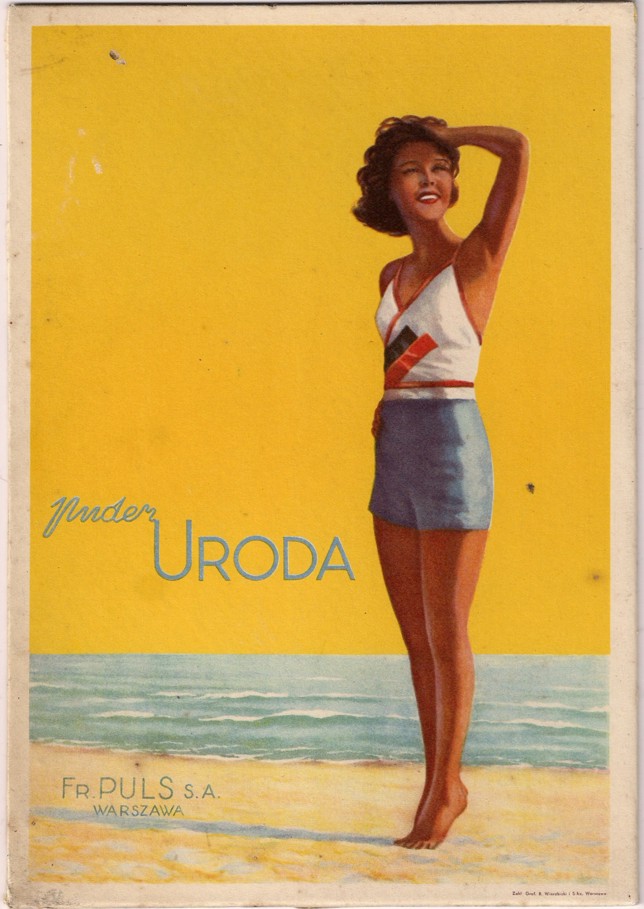
Jedną z marek kosmetyków Pulsa była przed II Wojną Światową marka "Uroda". Oferowano dwa produkty: puder (w wielu odcieniach) i krem, na opakowaniach i w reklamach pojawiała się charakterystyczna sylwetka kobiety w sportowym stroju plażowym. Po wojnie nazwa "Uroda" pojawiła się jako marka kosmetyków produkowanych w starej warszawskiej fabryce Schichta na Szwedzkiej a w później dołączyła do nazwy fabryki ("Pollena-Uroda").
Na rysunkach:
Reklama sklepowa pudru Uroda, lata trzydzieste XXw.
Reklamy prasowe kosmetyków Uroda, lata trzydzieste XXw.
Puszka po kremie Uroda, awers i rewers, lata trzydzieste XXw.
Puls' Uroda brand
Before the World War II the brand "Uroda" [Beauty] was one of brands of Puls' cosmetics. Two products were offered: face powder (in many shades) and cream, on packages and in advertisements a characteristic profile of the woman in the casual beachwear appeared. After the war the name "Uroda" turned up as the brand of cosmetics produced in the old Schicht's factory on Szwedzka street in Warsaw and later joined the factory name ("Pollena-Uroda").
On pictures:
Shop advertisement of the Uroda face powder, 1930's
Journal and newspaper ads of Uroda-brand cosmetics, 1930's.
Tin of the Uroda cream, the obverse and the reverse, 1930's
Na rysunkach:
Reklama sklepowa pudru Uroda, lata trzydzieste XXw.
Reklamy prasowe kosmetyków Uroda, lata trzydzieste XXw.
Puszka po kremie Uroda, awers i rewers, lata trzydzieste XXw.
Puls' Uroda brand
Before the World War II the brand "Uroda" [Beauty] was one of brands of Puls' cosmetics. Two products were offered: face powder (in many shades) and cream, on packages and in advertisements a characteristic profile of the woman in the casual beachwear appeared. After the war the name "Uroda" turned up as the brand of cosmetics produced in the old Schicht's factory on Szwedzka street in Warsaw and later joined the factory name ("Pollena-Uroda").
On pictures:
Shop advertisement of the Uroda face powder, 1930's
Journal and newspaper ads of Uroda-brand cosmetics, 1930's.
Tin of the Uroda cream, the obverse and the reverse, 1930's
poniedziałek, 2 maja 2011
Profesjonalnie
Przed II Wojną Światową funkcjonowały trzy grupy profesjonalistów związanych z obrotem kosmetykami: drogiści i aptekarze (którzy zarówno wytwarzali kosmetyki jak i sprzedawali kosmetyki produkowane przemysłowo), fryzjerzy oraz kosmetyczki. Do drogistów i do fryzjerów kierowano prasę profesjonalną taką jak np. „Trybuna drogistowska”, „Drogista” czy „Powszechna gazeta fryzjerska” w których oczywiście zamieszczano sporo reklam. W prasie kierowanej do fryzjerów widać sporo reklam typowych kosmetyków profesjonalnych, przeznaczonych do użycia w salonie, nie wprowadzanych na rynek detaliczny – dominują w tym zakresie reklamy farb do włosów oraz preparatów do trwałej ondulacji i modelowania fryzury. W prasie drogistowskiej i w podręcznikach kierowanych do drogistów jest sporo reklam kosmetyków rynkowych oraz surowców do wytwarzania kosmetyków jak również specyficzne reklamy mające na celu zwiększenie zainteresowanie drogistów obrotem wyrobami gotowymi, o których napiszę w jednym z następnym wpisów.
Prasa przeznaczona specjalnie dla kosmetyczek (lub fryzjerów i kosmetyczek) pojawiła się w Polsce stosunkowo późno, bo pod koniec lat trzydziestych, wcześniej zaczęły się pojawiać periodyki związane z kosmetyką lekarską. Tu oprócz reklam kosmetyków widać sporo reklam aparatury zabiegowej.
Na rysunkach:
Reklama aparatów lekarsko-kosmetycznych
Reklama farby do włosów L'Oreal. "Powszechna gazeta fryzjerska". 1929
Reklama wody do utrwalania ondulacji Ix (Odol). "Powszechna gazeta fryzjerska". 1929
Reklama surowców do produkcji kosmetyków.
Professionally
Before the World War II in Poland three groups of the professionals associated with the cosmetic trade existed: druggists and pharmacists (which both produced cosmetics and sold industrial-scale produced cosmetics), hairdressers and beauticians. To druggists and hairdressers a professional press was directed like e.g. "Trybuna drogistowska" [The Druggists’ Tribune], "Drogista" [The Druggist], “Powszechna gazeta fryzjerska” [General Newspaper for Hairdressers], where of course quite a lot of advertisements were being placed in. In the press directed to hairdressers quite a lot of advertisements of typical professional cosmetics, intended to use in the saloon, not led to the retail market were published - advertisements of hair dyes and preparations for permanent waving and hair setting are dominating. In the druggists’ journals and textbooks there are quite a lot of advertisements of cosmetics and raw materials for producing cosmetics as well as peculiar advertisements being aimed at increasing druggists’ interest in finished products resale, about which I’m going to write in one of next entries.
Journals for beauticians (or for both hairdressers and beauticians) appeared in Poland relatively late, at the end of 1930’s, earlier periodicals connected to medical cosmetology appeared. Here apart from advertisements of cosmetics one can see quite a lot of advertisements of professional apparatuses.
On pictures:
Advertisement of medical-cosmetic apparatuses
Advertisement of the L'Oreal hair dye. "Powszechna gazeta fryzjerska". 1929
Advertisement of waving lotion Ix (Odol). "Powszechna gazeta fryzjerska". 1929
Advertisement of Itron cosmetic raw materials
sobota, 30 kwietnia 2011
Antiba - prasowe reklamy pudru
Seria reklam prasowych pudru Antiba, prasa ilustrowana, późne lata trzydzieste XX w.
The series of Antiba powder ads from illustrated magazines, late 1930's.
[Why to keep such a lovely face behind cards? Using Antiba powder, you are looking charmingly even at the bridge lasting till the morning.]
[With the fox you looks beautiful, but it would be a hundred times more nicely, if for you didn't cover your lovely face with such a fresh complexion. Only an Antiba powder is ensuring such a complexion.]
[Ah these fruits! It is necessary to take them off the table, because are covering the view for us for you. So pretty and matt complexion you could have only then, when you constantly are using Antiba powder which is uncomparable.]
[You are still reading and covering the face. We ask to put the book back, because is pleasantly to look at you. Since you are constantly using Antiba powder, your complexion is really ravishing.]
[The more transparent veil would be more appropriate. We could then delight our eyes with the view of your miraculous complexion. You owe such a complexion to permanent using Antiba powder.]
Subskrybuj:
Komentarze (Atom)


